
Voyageur
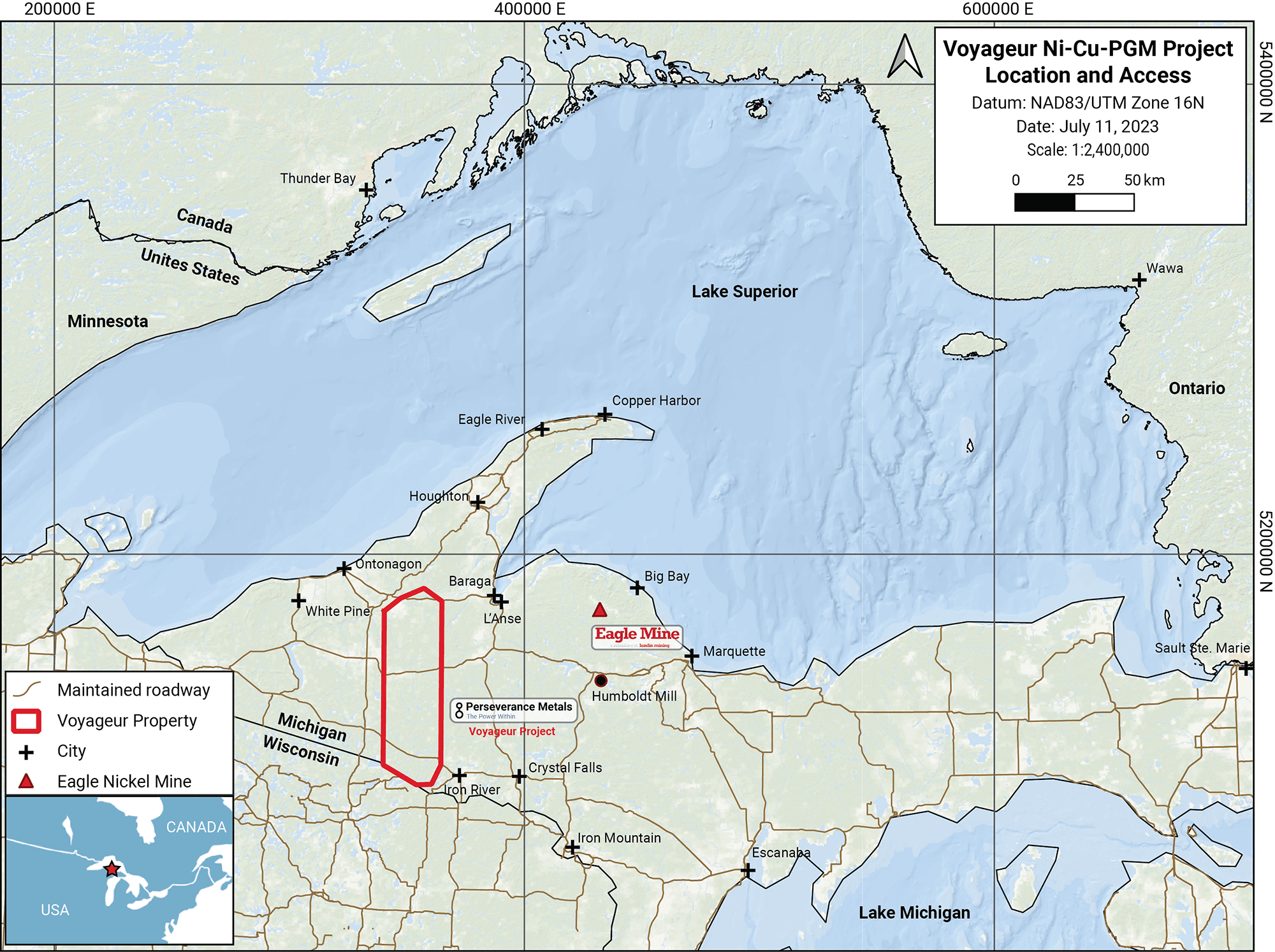
| Location | Upper Peninsula, Michigan, USA |
| Ownership | Optioned for 100% |
| Exploration Stage | Drilling |
| Deposit Type | Conduit-hosted magmatic nickel-copper-PGE |
| Property Size | 67,988 ha (~680 km2) |
Exploration
- The 2024 exploration program on the Voyageur project consisted of reprocessing and interpretation of existing geophysical datasets – notably the 2016 “VTEM Plus” airborne electromagnetic survey over the southern half of the Voyageur Lands – and targeted ground geophysical programs on resulting targets.
- An early 2026 exploration drill program with the intent to drill 2-3,000 metres is currently planned.
Exploration activities in the region, including Rio Tinto, have focused on magmatic sulfide deposits containing Ni, Cu and PGM elements. Rocks of the 1.1-billion-year-old Midcontinent Rift igneous event in the Lake Superior region have similarities to the host rocks of well-known nickel deposits such as Voisey’s Bay nickel-copper-cobalt deposit in Labrador, and the Noril’sk nickel-copper-PGM deposits in Russia, suggest potential for the discovery of similar deposits in Michigan.
History
- Bitterroot Resources Ltd.’s Michigan subsidiary, Trans Superior Resources, Inc. (Trans Superior), has been the operator of the Voyageur mineral rights since 1996. Altius Minerals Corporation (Altius) entered into an exploration agreement with Trans Superior in 2015 and contracted a “VTEM Plus” electromagnetic survey over the southern and central Voyageur lands.
- Exploration of the property has consisted of geophysical surveys and limited field mapping from 1996 to 2015, including airborne magnetic, and some electromagnetic surveys.
- Only 16 diamond drill holes have been drilled on the property:
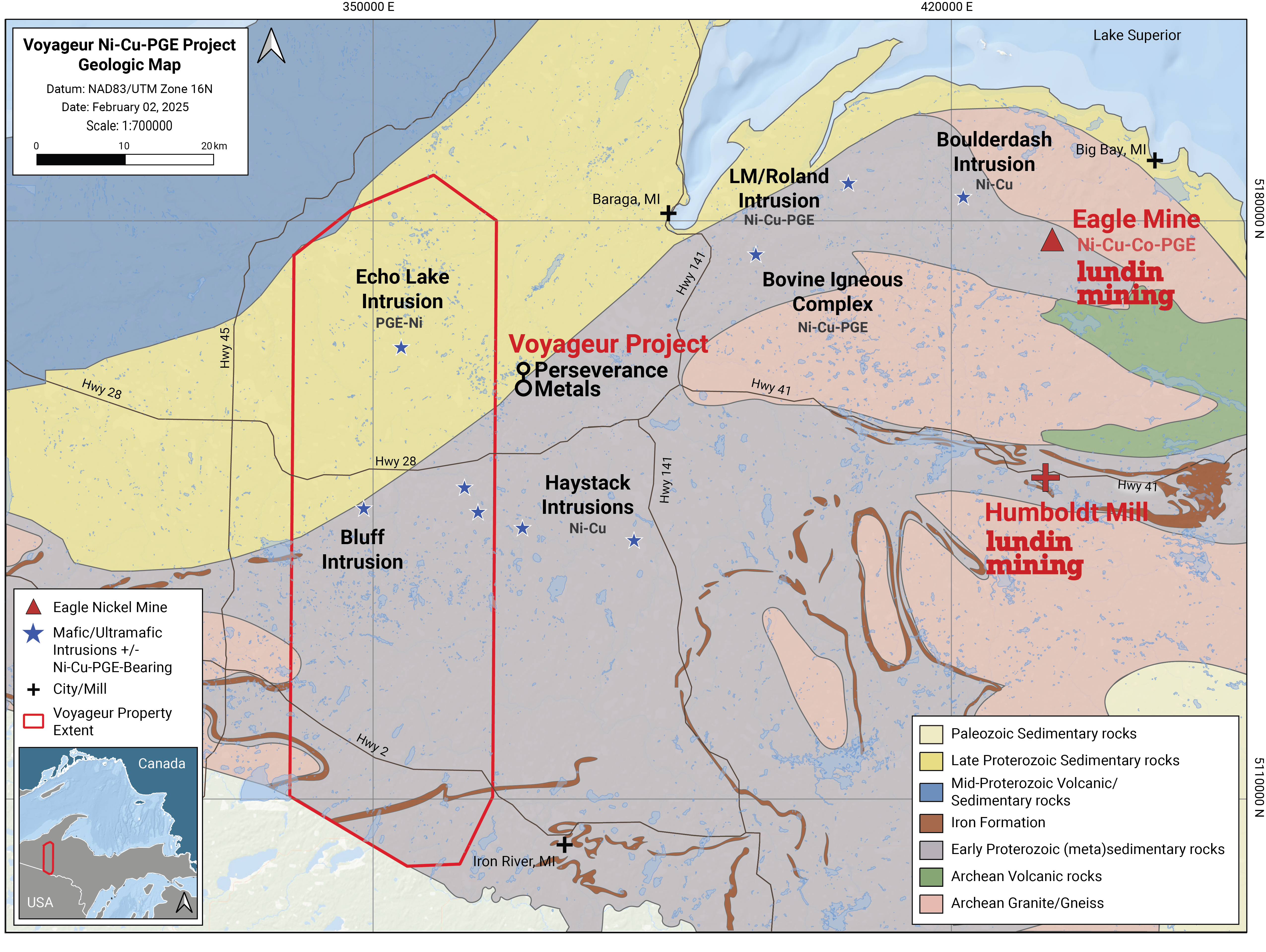
- 5 holes to test the Echo Lake layered intrusion with disseminated sulfide mineralization encountered at 990 metres depth that returned 1.01 g/t Pt+Pd+Au over 5.4 meters, within a 21.3-metre interval grading 0.52 g/t Pt+Pd+Au
- 11 holes on two geophysical targets within the Haystack area. No significant mineralization was encountered from the Haystack drill program.
Geology
- The geology of the western Upper Peninsula is comprised of Archean, early Proterozoic, middle Proterozoic, and late Proterozoic rocks, extensively covered by varying thicknesses of glacial deposits.
- Most of the southern part of the Voyageur Lands are mapped as early Proterozoic marine clastic meta-sedimentary rocks, which unconformably overly the Archean basement. The overlying middle Proterozoic rocks, exposed farther to the north, are volcanic and sedimentary strata comprising the Keweenawan Supergroup and lesser intrusive rocks emplaced in them.
- Throughout the south part of the Voyageur Property, and surrounding area, large regionally extensive dikes of diabase (Marquette-Baraga dike swarm) are common, and cut both early flows and older basement rocks. The dikes were emplaced in deep-seated crustal fractures, mostly in the earlier stages of rift evolution, probably roughly synchronous with eruption of the oldest Keweenawan volcanics.